- Clinicians spend 5-10 minutes per visit fixing AI scribe errors. Here's what the data shows about ambient documentation's real workflow impact — and what works.
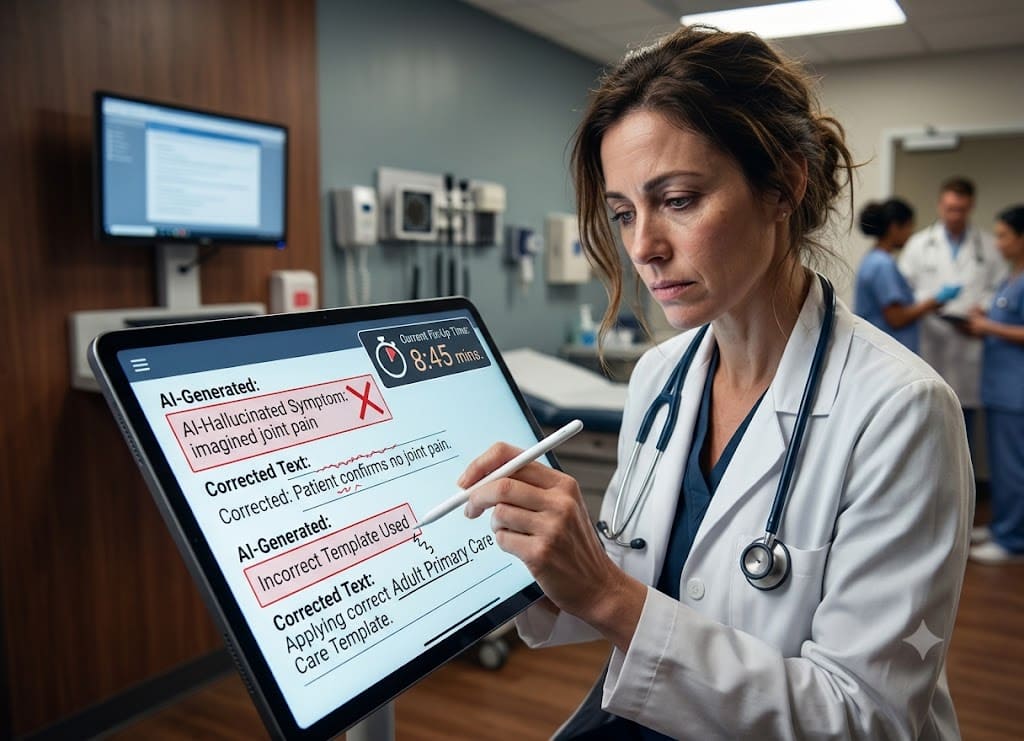
Every demo shows the same thing: an AI assistant listens to a visit, generates a perfect note in seconds, the clinician smiles. The reality? A nurse practitioner I know spends the first ten minutes of her lunch break deleting fake symptoms her AI scribe added to the record. Wrong template. Extra fluff. Details the patient never said.
This gap between the demo and the floor isn't an edge case.
The 10-Minute Fix-Up Nobody Talks About
A post on r/healthIT with 107 upvotes and 41 comments puts it plainly: "I'm seeing all these demos where an 'AI assistant' listens to the visit, generates a note, then the clinician has to spend 5–10 minutes fixing the same three things every time."
The same three things. Every time.
When a busy practitioner — already behind on their schedule — has to spend ten minutes per visit deleting and rewriting AI-generated text, the "time-saving" device becomes a time drain. Worse, it adds to the cognitive load it was supposed to reduce. You're not just editing a note. You're second-guessing whether the AI hallucinated something that could end up in a patient's permanent record.
What Microsoft's Survey Actually Found
Here's what the data says. Microsoft's Dragon Copilot survey covered 879 clinicians across 340 healthcare organizations — one of the largest real-world studies on AI-assisted documentation. The headline numbers are strong:
- 70% of clinicians reported reduced feelings of burnout and fatigue
- 62% said they were more likely to stay in their current role
- 93% of patients reported a better overall experience
These aren't small effects. For a clinic operator deciding whether to invest in voice AI, these numbers say: done right, this technology works.
But here's what the survey doesn't tell you. The clinicians in this study were using a mature, enterprise-grade system — Microsoft's Dragon Copilot, built on years of Nuance acquisition and tight EHR integration. That's not the same as the startup demo you saw at a conference last month where the AI hallucinated a patient's medication list.
A separate analysis from MIT Technology Review found that 65% of US hospitals already use AI-assisted tools, but only two-thirds of those hospitals actually measure whether the tools help. The rest are spending on AI without knowing if it works in their specific setting.
The Problem With "Set It and Forget It" AI
The real issue isn't the technology. It's the gap between what AI scribes promise and what they deliver in a real clinic with real patients who don't always talk in tidy sentences.
Most ambient documentation tools share the same limitation: they're built to produce a note, not to capture a conversation's full context. A patient might mention they're stressed about work — the AI often ignores this because it doesn't fit the note template. But that stress signal is why the patient came in.
When the AI filters out the context, the clinician loses the thread. The follow-up call that could have addressed the real problem never happens. The patient feels unheard. And the clinic loses a visit that could have been a check-in, a refill, or a referral.
The hidden cost of a "good enough" AI note: the follow-up revenue and patient trust you leave on the table.
What Clinic Operators Can Do Today
If you're running a clinic or consulting on healthcare technology, here's the practical takeaway:
- Don't buy the demo. Ask for a 30-day pilot in your lowest-volume clinic with your busiest provider. The test isn't whether the note looks right — it's whether the clinician has to edit it.
- Look for AI that captures, not just transcribes. Tools that flag patient signals — concerns, compliance issues, follow-up needs — beat tools that only produce a clean note. The real value isn't in the record. It's in the next action you didn't have to figure out manually.
- Measure the fix-up time. If your providers are spending more than 2 minutes editing an AI-generated note, the tool is costing you money, not saving it.
Final Word from the Trenches
"AI in health care right now is just really fancy copy-paste."
That r/healthIT user isn't wrong — for a lot of tools on the market today. But the technology itself isn't the problem. The problem is the gap between what a demo shows and what a real patient encounter demands.
The clinics that succeed with voice AI aren't the ones with the fanciest tools. They're the ones that treat the AI as a junior partner — worth checking, worth correcting, and worth keeping around for what it catches that the human missed.
Because when it works right — when the capture is clean, the context is preserved, and the follow-up is automatic — that 70% burnout reduction and 93% patient satisfaction isn't a survey number. It's your clinic's waiting room on a Tuesday morning, with patients who keep coming back.
Frequently Asked Questions
How much time do clinicians spend fixing AI scribe errors?
Clinicians report spending 5 to 10 minutes per visit correcting the same recurring AI errors — wrong templates, extra fluff, and hallucinated details. If your team averages more than 2 minutes of edits per note, the tool may be costing time rather than saving it.
Are ambient AI scribes actually reducing clinician burnout?
A Microsoft Dragon Copilot survey of 879 clinicians across 340 organizations found 70% reported reduced burnout and 62% were more likely to stay in their role. However, these results come from mature enterprise systems — not all AI scribes perform at this level.
What should clinic operators look for when evaluating voice AI?
Run a 30-day pilot with your busiest provider in your lowest-volume clinic. Measure the fix-up time on each AI-generated note. Look for tools that capture patient signals (concerns, compliance issues, follow-up needs) rather than just producing clean transcripts.