"I used the exact script from a six-hour consultative selling workshop. The client paused and asked, 'Are you reading from a script?' Then they hung up."
That storyative selling approach made a client say "Are you reading from a script?" and hang up. The post got 1,023 upvotes and 329 comments — not because the story was unusual, but because almost everyone had been there. Standardized sales training has a retention problem so severe that most of it does not stick past the first month.

Why Standardized Training Keeps Failing
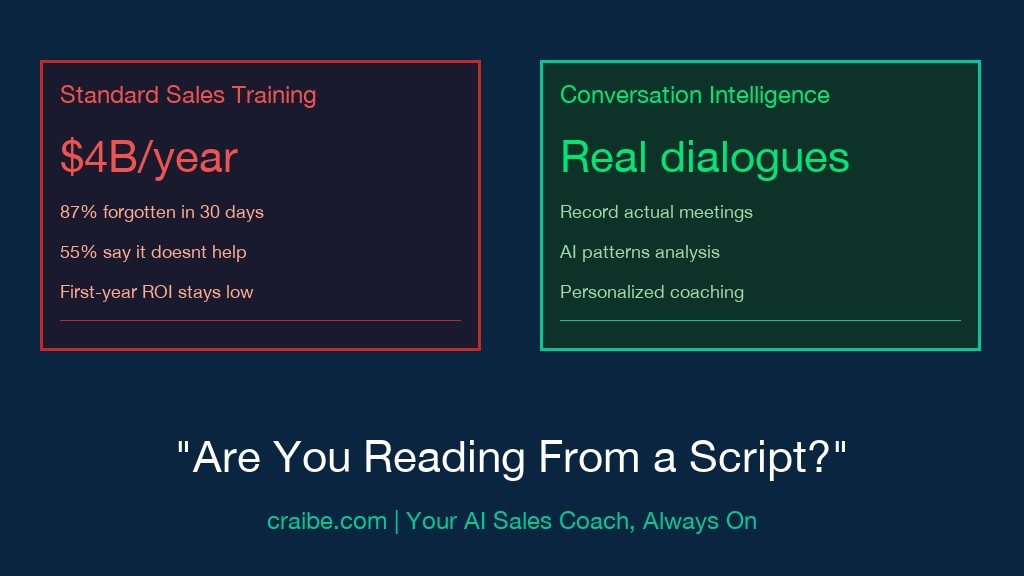
Companies in the US spend an estimated $4 billion on sales training every year. Studies across multiple sources show that 87% of that content is forgotten within 30 days. Only about 35% is still being applied a year later. Among sales reps themselves, 55% say their training does not help their actual performance. And 70% of sales enablement programs fail to show measurable ROI, according to multiple industry analyses [ZipDo].
Ongoing coaching changes the picture. Companies that stay with coaching beyond initial training see roughly 17% higher win rates compared to those that rely on one-off training events [ZipDo]. The gap between a single workshop and continuous practice is the difference between information and skill.
The Reddit Moment That Says It All
The core of the story is simple. A salesperson completed a 6-hour consultative selling session, memorized the script, and went into a real call. Within minutes, the client smelled it. The comments section is full of experienced reps saying the same thing: scripts kill trust.
"Am I the only one who thinks most sales training is theater? Objection handling roleplay. Discovery frameworks. Closing techniques. Meanwhile the actual skills that matter: Responding fast, not forgetting to follow up, actually listening." — r/sales (427 upvotes)
Another thread, with 180 upvotes, features a rep earning $300K per year calling external sales training "one of the most painful parts of my job." And a retired rep with an $800K peak year summed it up in a different thread (5,428 upvotes):
"CRM is a tool that won't teach you how to sell anything. It's an HR tool." — r/sales (5,428 upvotes)
The pattern across these four independently posted threads is consistent. Practitioners at every level — from newcomers to top earners — recognize that standard training does not translate to better real conversations. The training itself is not the problem. The delivery model is.

What the Data Actually Shows
The industry does not publish many longitudinal studies on training effectiveness. Most of the available data comes from aggregated sources and vendor surveys. From what we have:
- Retention is the primary failure point. Reps need an estimated 6-8 practice touches to retain a new technique, but most training formats deliver the material once and move on [ZipDo].
- Application rates are low. Only about 1 in 4 salespeople actually applies their training to the job [ZipDo]. The other three go back to what they were doing before.
- Cost per rep is tangible. The average organization spends an estimated $1,800 per rep per year on training [ZipDo]. Most of that spend does not produce a measurable change in behavior.
- First-year ROI remains low. For most organizations, the return on training investment in the first year does not justify the cost. This is why so many programs get cut.
Does sales training work? It depends. A workshop with a deck and a role-play? For most people, no. An ongoing system that analyzes actual conversations and provides feedback on real dialogues? The evidence suggests that works much better.
What Top Performers Do Differently
The emerging answer — visible both in the Reddit threads and in the startup ecosystem — is conversation intelligence. Instead of teaching reps what to say in a hypothetical scenario, this approach records real conversations with clients, analyzes the dialogue, and surfaces patterns that work.
Companies like Gong.io have built their business around this thesis: standard training does not work, and real conversation data is the answer. A growing ecosystem of tools — Onsa.ai (intelligent sales meeting prep), Selli.app (real-time AI assistant for sales calls on macOS), and SpeakStruct.co (voice-to-structured-data for sales analysis) — points to the same conclusion.

Top performers do three things that average reps do not:
- They review their own conversations. Not just win rate numbers, but the actual dialogue. What did they say when the client raised an objection? How did they handle the price question?
- They learn from patterns, not scripts. Instead of memorizing a script, they study what works in their own voice and style, then repeat those patterns.
- They practice on real interactions. Role-play is artificial. The feedback that changes behavior comes from analyzing what actually happened in a real meeting.
This is not theoretical. It is what the reps in those Reddit threads are already doing — at least the ones who are not stuck in scripted training programs they call "theater."
How Craibe AI Changes the Equation
Craibe AI was built for exactly this gap. It is a conversation analysis tool — not a training platform — that records face-to-face client meetings and phone calls, then analyzes the dialogue to show what worked and what did not. For clinic operators, health supplement sales teams, and insurance agents who meet clients in person, Craibe provides the same kind of conversation intelligence that enterprise teams get from Gong, but adapted for in-person, relationship-driven sales.
Instead of handing a rep a script and sending them into the field, Craibe helps them learn from their own conversations. No role-play. No one-size-fits-all script. Just real data from real dialogues, surfaced in a way that makes the next conversation better.
Transform Every Conversation into Revenue. Your AI Sales Coach, Always On.
References
- Sales Training Statistics — ZipDo (2025) — Aggregated industry data on sales training retention, application, cost, and coaching impact. Sources include Xerox, LinkedIn research, and multiple independent studies.
- Reddit r/sales — Client hung up after scripted training (1,023 upvotes) — First-hand practitioner story of a standardized training script causing a lost deal.
- Reddit r/sales — "Sales training is theater" (427 upvotes) — Practitioner thread questioning the value of conventional sales training.
- Reddit r/sales — $300K earner calls training "most painful part of the job" (180 upvotes) — Experienced rep's frustration with external training programs.
- Reddit r/sales — Retired $800K top earner on CRM and training (5,428 upvotes) — Veteran perspective on the gap between tools and real selling skills.